· by Michael Blair, Nashville's Air Duct Cleaning
Late September and October are when mice start moving from the yard and the woodpile toward anything warm, and a Middle Tennessee house with its ducts in a vented crawl space or an attic gives them a heated tunnel straight to every room. Most homeowners find out the first week the heat runs, when a smell comes out of the registers that was not there in the spring. Cleaning the ducts is part of the answer, but only part, and doing it in the wrong order means paying for it twice.
How they get into a duct system
Flexible duct is the usual way in. It is a thin plastic liner inside a sleeve of insulation, and a mouse can chew through it in a night. Runs that have come loose from their boots, sagging sections lying on the crawl space floor and joints held with tape that let go years ago all leave openings a mouse will find without chewing at all.
The return side is the worse problem. In many older Nashville houses the return is a platform or a panned-over floor joist bay in the crawl space rather than a sealed duct, and any gap in it draws crawl space air, and whatever is living there, into the system under suction. Anything a mouse leaves on the return side goes through the blower and out to the house.
Signs that point to the ducts rather than the walls
A sour, ammonia-like smell that shows up when the system starts and fades when it stops is the clearest one, because it follows the airflow rather than a room. Droppings on the floor right under a register, or visible when the grille comes off, are the other. Scratching that you hear in the floor near a vent, especially at night when the house is quiet, is a third.
Look under the house with a flashlight if the crawl space is reachable. Chewed flex, insulation pulled out in tufts and nests of shredded material near the air handler all confirm it, and they also show where the damage is, which matters for what comes next.
- A smell that comes and goes with the blower
- Droppings at or inside the registers
- Scratching near a vent after dark
- Chewed flex or pulled insulation under the house
- Nesting material near the air handler or return
The order the work has to happen in
Entry points first. The gaps in the foundation, the vents without screens and the utility penetrations have to be closed, and the mice already inside have to be dealt with, which is pest control work. Cleaning ducts while mice can still get into them buys a few clean weeks.
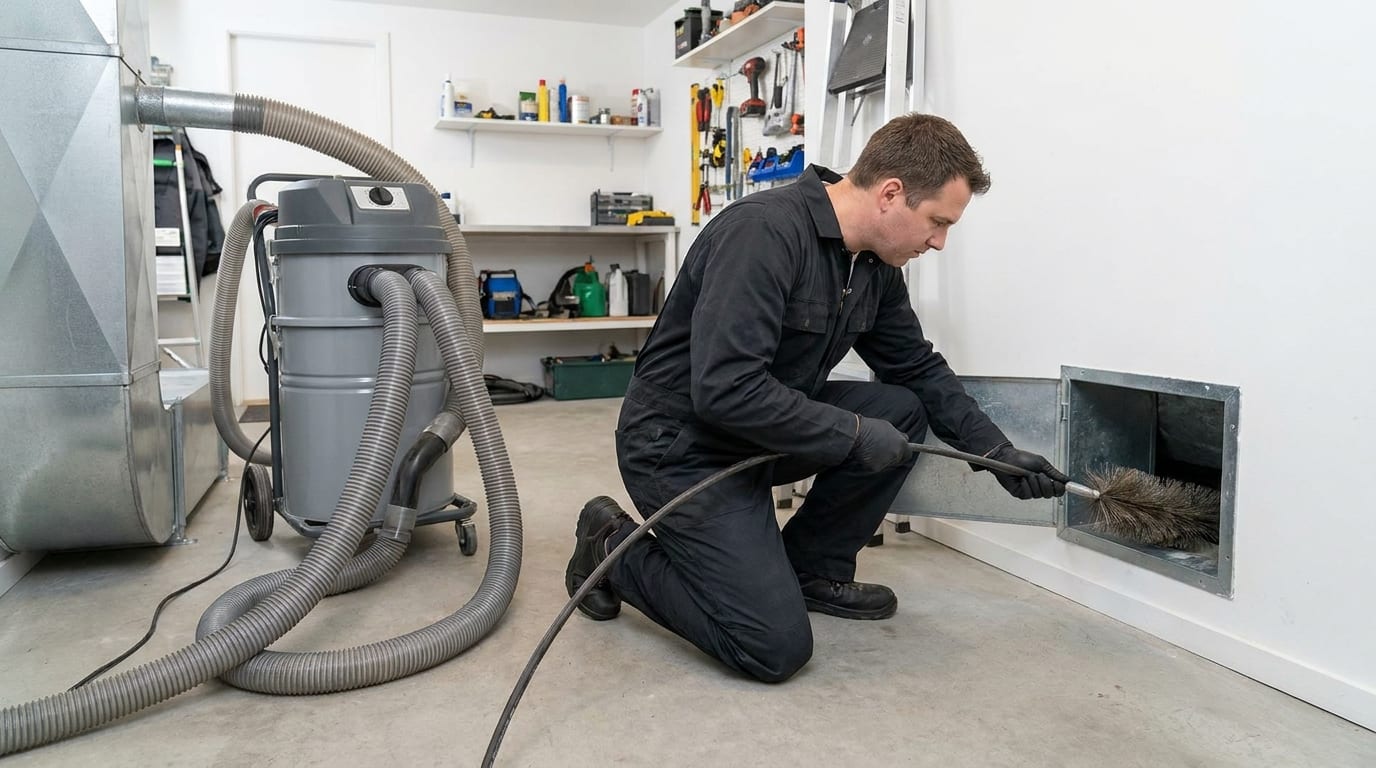
Then the ducts get repaired. Chewed flex is replaced rather than patched, because the liner is what keeps air in and the insulation is usually soiled beyond saving. Loose runs are reattached and sealed at the boots, and an open return platform is sealed or rebuilt. Only then does cleaning make sense, with the system under negative pressure so nothing loosened ends up in the rooms, the blower wheel and the coil included, and the filter changed at the end.
Handling droppings safely
Do not sweep or vacuum droppings dry, at a register or anywhere else. The CDC advice for rodent cleanup is to ventilate the area, wet the droppings and nesting with a disinfectant or a diluted bleach solution, let it sit, and wipe it up with paper towels while wearing gloves. Dry sweeping puts the dust in the air, and a household vacuum without a sealed filter spreads it.
Fogging or spraying a sanitizer into the ducts is not a substitute for taking the contamination out. It covers the smell for a while and leaves the droppings and soiled insulation where they were. If a company offers fogging alone for a rodent problem, ask what happens to what is already in the runs.