
· by Michael Blair, Nashville's Air Duct Cleaning
Some dryer vents were never going to stay clean, however often they are brushed out. In those houses the run is too long, it climbs through the attic to the roof, the foil hose behind the dryer is crushed against the wall, or the joints are held with screws that catch lint on every load. Cleaning buys a few months; the duct itself is the fault.
Tennessee’s state-adopted residential code spells out what a dryer exhaust has to be, and the Department of Energy’s building guidance fills in the details. Here is what both ask for, which is the standard we hold ourselves to when we install a new vent or reroute an old one.
What does the code require for a dryer vent?
The code requires a dryer vent to be its own metal duct that carries the moist air outdoors and nowhere else. In the 2018 International Residential Code as adopted in Tennessee, Section M1502, the exhaust must be independent of every other system, built of metal at least 0.0157 inch thick (No. 28 gage) and 4 inches in nominal diameter, and supported at least every 12 feet. Screws or similar fasteners may not poke more than 1/8 inch inside at the joints, because lint hangs on them.
The Building America Solution Center’s guide to proper clothes dryer venting, a Department of Energy resource kept by its Pacific Northwest lab, adds the practical side. It calls for galvanized steel or aluminum duct, rigid or semi-rigid, smooth on the inside, joints that point in the direction the air flows, clamps or foil tape at the joints, and a slight downward slope of a quarter inch per foot toward the outside so condensation drains. It rules out PVC and the spiral-wound kinds that trap lint.
How far can a dryer vent run?
A dryer vent can run 35 feet under the code’s default rule, counted from the end of the transition hose to the hood outside, and every fitting shortens that limit. Table M1502.4.5.1 assigns each elbow an equivalent length. A 90-degree mitered elbow of 4-inch radius counts as 5 feet and a 45 counts as 2 feet 6 inches, while long sweeping elbows count far less: a smooth 90 with a 6-inch radius is 1 foot 9 inches.
The arithmetic is worth doing before anything is cut. Three tight 90s take 15 feet off the allowance and leave 20 feet of straight duct; the same run with smooth long-radius elbows keeps nearly all of it.
There are two ways past the 35 feet. The code lets the dryer manufacturer’s installation instructions set the maximum instead, with a copy given to the code official at the concealment inspection, and it accepts a booster fan listed to UL 705 for dryer exhaust. Any run whose equivalent length passes 35 feet has to carry a permanent label within 6 feet of the dryer connection saying how long it is, so the next dryer bought for that house is chosen to match.
What connects the dryer to the wall?
A transition duct connects the dryer to the wall, and the code allows only one kind: a single length, listed and labeled to UL 2158A, no longer than 8 feet. It does not count toward the 35 feet, which is one more reason to keep it short.
The Consumer Product Safety Commission’s dryer fire sheet explains why the old white plastic and silver foil accordion hoses go. It says most dryer makers specify rigid or corrugated semi-rigid metal for the most airflow, and that the flexible plastic and foil kinds trap lint more easily and kink or crush when the dryer is pushed back. A crushed transition behind the machine gets checked early on every dryer vent cleaning we do.
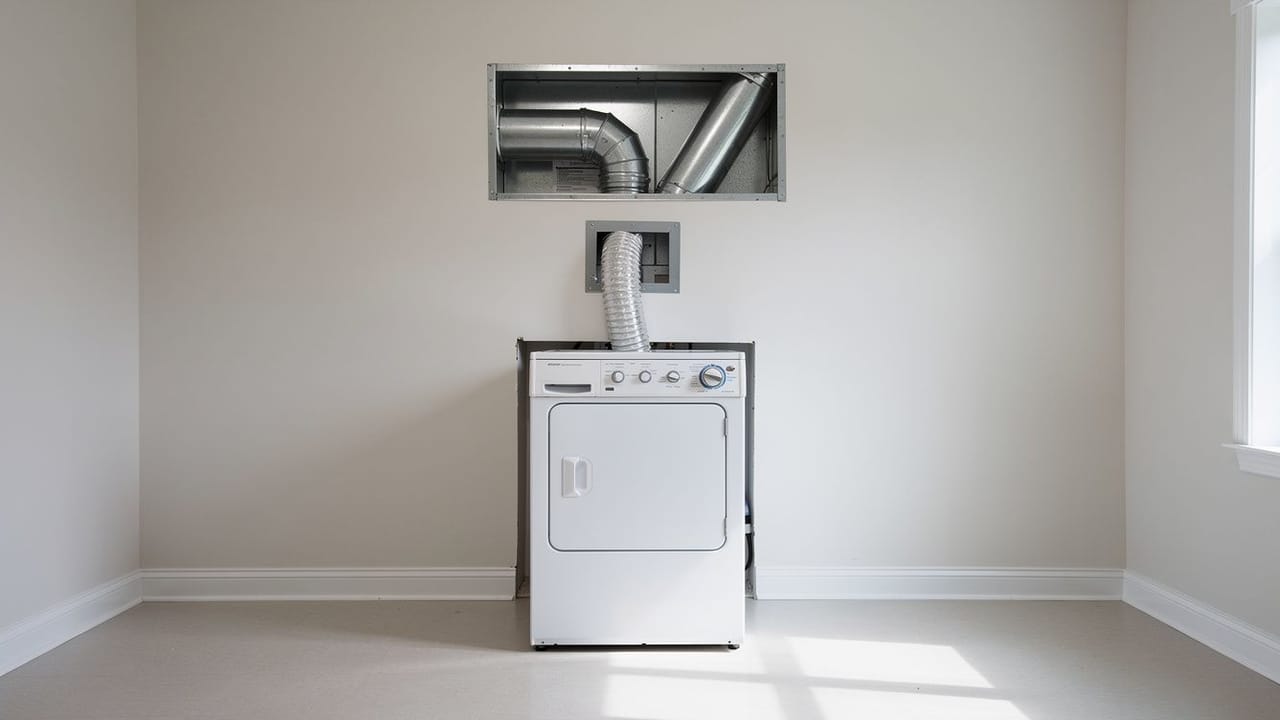
Where the dryer has to sit close to the wall, the Building America guide suggests a telescoping rigid metal transition or a recessed dryer box set into the wall, which lets the duct leave the dryer straight instead of folding.
Where should a dryer vent end outside?
A dryer vent should end on an outside wall, low and away from windows and doors, in a hood fitted with a damper and left unscreened. Unless the dryer’s instructions name another spot, the code keeps the outlet 3 feet or more from any door, window or other opening, requires a backdraft damper, and bans screens, which clog with lint.
The Building America guide goes further. It advises against ending the vent on the roof, asks for the hood to point down at least 12 inches above the ground, and keeps it 10 feet from an air conditioner or heat pump condenser. It prefers a louvered damper to a single flap. A duct that climbs to the roof should be rerouted to a shorter, flatter path where the house allows; where it does not, an in-line booster fan is the fallback.
The one place a dryer must never vent is inside the house. The guide warns that venting into an attic, a crawl space or a wall cavity invites dampness and mold, and in the vented crawl spaces under so many Middle Tennessee houses that moisture has nowhere useful to go. If you are in Lebanon or anywhere nearby and the dryer takes two cycles, read our post on why the dryer vent matters, then ask us to look at the run.
Sources
- International Residential Code 2018, Section M1502 Clothes Dryer Exhaust (Tennessee state-adopted edition, UpCodes) — Independent exhaust to outdoors; termination 3 feet from openings with a backdraft damper and no screen; No. 28 gage metal, 4-inch; supports every 12 feet; no fasteners protruding more than 1/8 inch; UL 2158A transition no longer than 8 feet; UL 705 power ventilators; 35-foot limit and Table M1502.4.5.1; manufacturer alternative; length label within 6 feet
- U.S. Department of Energy, Building America Solution Center (PNNL), Proper Clothes Dryer Venting — Smooth galvanized metal, no PVC or spiral duct; slope and joint direction; clamps or foil tape; telescoping transition or wall box; avoid roof termination; hood down 12 inches above grade, 10 feet from a condenser; louvered damper; booster fan; never into attic or crawl space
- U.S. Consumer Product Safety Commission, Overheated Clothes Dryers Can Cause Fires (Publication 5022) — Replace plastic or foil accordion duct with rigid or corrugated semi-rigid metal; flexible duct traps lint and kinks or crushes
FAQ
Dryer Vent Installation: What the Code Requires — questions
How long can a dryer vent be run with elbows?
Under Tennessee’s 2018 residential code the default limit is 35 feet, reduced for every fitting: 5 feet for each tight 90-degree elbow and 2 feet 6 inches for each tight 45. Smooth long-radius elbows cost much less. The dryer maker’s instructions may allow a longer run, and a listed booster fan is the other option.
Can a dryer vent go up through the roof?
The code does not forbid it, but the Department of Energy’s Building America guide advises against ending a dryer vent on the roof. A run that climbs is long and works against gravity, so lint settles in it. The guide says to reroute to a shorter, flatter path where possible, or add an in-line booster fan.
Can dryer vent duct be joined with screws?
Not with screws that stick into the airflow. The residential code bars screws or similar fasteners that poke more than 1/8 inch inside, because lint catches on them. The Building America guide recommends joining sections with clamps or foil tape, with each joint pointing in the direction the air moves.
Does a dryer vent need a backdraft damper outside?
Yes. The 2018 residential code adopted in Tennessee requires a backdraft damper at the termination and forbids a screen there, since a screen clogs with lint. The Department of Energy’s Building America guide prefers a louvered damper to a single hinged flap and recommends replacing screened hoods.
Can a dryer vent be PVC pipe?
No. The residential code requires dryer exhaust duct to be metal at least No. 28 gage, and the Department of Energy’s Building America guide says PVC is not allowed by any standard or specification it lists. It also rules out vinyl, nylon and foil duct and spiral-wound designs that trap lint.